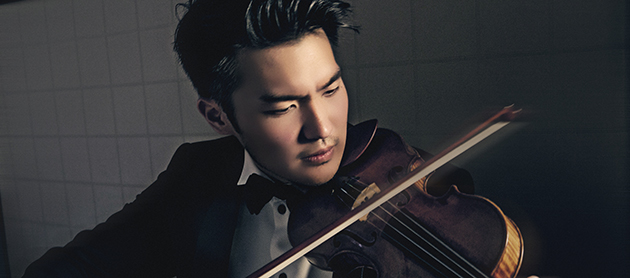
Remarkably, Ludwig van Beethoven wrote but one violin concerto in his prodigious lifetime. While this alone makes the concerto special, it also has become one of the most widely played and popular works for the instrument. Under the spotlight for Pacific Symphony’s first concert of 2018, the concerto is famous for its highly spirited final movement. The work’s grandeur—every bit as lush as any of his piano concertos—reveals the amazing melodic and technical range of the violin, especially when played by Taiwanese-Australian violinist, Ray Chen. The Washington Post declared: “Chen can do pretty much anything he wants on the violin.” The orchestra also tackles Edward Elgar’s regal Symphony No. 1, a work performed over 100 times within a year of its premiere. It was hailed by The Musical Times as an “immediate and phenomenal success.”
Led by international guest conductor and British native Michael Francis, the Symphony’s musical toast to the New Year takes place Thursday through Saturday, Jan. 11-13, at 8 p.m. in the Renée and Henry Segerstrom Concert Hall. Tickets are $25-$126; Box Circle, $196-$206. A preview talk with Alan Chapman begins at 7 p.m. For more information or to purchase tickets, call (714) 755-5799 or visit PacificSymphony.org.
Reviewing a performance of Elgar’s Symphony No. 1 led by Francis, the Tampa Bay Times, wrote: “Elgar’s attempts to work out his demons brought out the most passion in Francis, who might have galloped off the stage with the military rhythms of the orchestra. A few magic moments had everyone in the theater syncopated, tied together in the sights and sounds. And that felt most significant of all.”
The concert opens with Beethoven’s extraordinary violin concerto. After sharing a thrilling performance with Chen a few years ago, the Symphony felt compelled to invite him back for this occasion. The Strad sums up Chen: “From the first notes there was no doubt of being in the presence of something special.” This first prizewinner in the 2008 International Yehudi Menuhin Violin Competition and 2009 Queen Elisabeth Music Competition will dazzle with Beethoven’s jewel.
Despite a shaky genesis, Beethoven’s only violin concerto, admired for its innovative nature and sheer beauty, remains enormously popular. Composed in 1806 in Vienna for one of the best-known virtuosos of the day, Franz Clement, the concerto epitomizes the classical concerto form and exceeds the scale of any violin concerto before it. The melody and rhythmic material are among the most moving in the entire repertoire, and the finale is one of Beethoven’s most brilliant movements, exhilarating and energetic throughout. Filled with charming dialogues between the soloist and the rest of the orchestra, the mood of the work is unquestioningly vivacious. With nary a note out of place, the musical journey is sublime.
However, despite Beethoven’s unfailing confidence in his work (bragging that violinists would still be playing it 50 years after his death), the concerto’s history is not golden. Having completed the work in a mad rush just two days before its premiere, the surviving score is a mass of corrections and alternative versions. Clement had very little time to learn the work or rehearse it with the orchestra. And, during the concert, Clement also played a piece of his own while holding the violin upside down, which didn’t endear the critics, and may have adversely affected their reaction to the concerto. The press sourly wrote: “Beethoven could put his undoubtedly great talents to better uses.”
As a result, the concerto went unappreciated and neglected—until Josef Joachim and Felix Mendelssohn championed it in the 1840s. It was then that it finally gained a reputation for being one of the greatest works of the genre. Written 21 years before Beethoven’s death, the composition’s immediate fate belied Beethoven’s belief in its success, but in the end, it was redeemed. Beethoven was simply not alive to know it.
The struggle of the masters to claim their place in history doesn’t stop with Beethoven. Elgar (1857-1934)—who is credited with lifting British music out of the two centuries of mediocrity—was already 50 when he began what became his First Symphony. Technically, it was not his first stab at a symphony. Elgar had composed one inspired by Mozart 30 years earlier (only one movement survives), and in 1898, he attempted a symphony dedicated to the life of the English military-imperial hero General Gordon, which did not get far.
By the early 20th century, people were wondering if the symphony had any kind of a future at all. A number of composers of Elgar’s generation were moving away from the symphony, yet, he remained convinced of its worth and sustainability. In a 1905 lecture at Birmingham University, Elgar said: “It seems to me that because the greatest genius of our days, Richard Strauss, recognizes the symphonic-poem as a fit vehicle for his splendid achievements, some writers are inclined to be positive that the symphony is dead…but when the looked-for genius comes, it may be absolutely revived.”
Elgar proved to be that genius. It was just a few years later, in December 1908, that he wrote and premiered his much-anticipated Symphony No. 1, which far exceeded his earlier attempts and broke the notion of the symphony’s demise. Thoroughly English, the Symphony is noble, regal and dramatic. Richly scored, luxuriantly melodic and full of gravitas, it was a huge success and very popular after its premiere. In fact, it was hailed as the greatest British symphony ever written. Unfortunately, it has not fared as well since—making it a rare treat on the concert stage. Fortunately, like Beethoven’s violin concerto, it is music that has transcended time and place to be admired by today’s generations.
Pacific Symphony’s Classical Series is made possible by the Hal and Jeanette Segerstrom Family Foundation, with additional support from The Westin South Coast Plaza KUSC and PBS SoCal.
Photo: Ray Chen, Photo Credit: Sophie Zhai
Pacific Symphony Opens The New Year With Beethoven's First And Only Violin Concerto Performed By Virtuoso Ray Chen; Elgar's Symphony No. 1 Rounds Out Concert Of Firsts